
Programme roles
Look at planning, coordination, budgets and reporting responsibilities. Match your examples to the activities advertised.

Explore NGO and development jobs in Timor-Leste and compare the work each role involves. Check the organisation, programme, duty station and eligibility before applying. This category includes both non-governmental organisations and other development-programme employers.
Newest first · Showing 1–2
Work with purpose
Explore programme, community and technical work. Focus on the responsibilities you can support with real experience, then check the organisation, duty station and eligibility.
Explore the vacancies
Find your contribution
Explore your options
Choose a useful starting point, then read the requirements in each vacancy.
Look at planning, coordination, budgets and reporting responsibilities. Match your examples to the activities advertised.
Check the communities served, field travel, language requirements and practical arrangements.
Read the discipline, deliverables and level of expertise. An NGO, UN agency and development contractor are different employers.
A view of these results
A programme role, consultancy or internship can have different working arrangements. Compare the displayed job types, then read the specific contract and travel requirements.
2vacancies across all results pages
Counts cover all result pages. A job may have more than one type.
Make a stronger choice
Connect your experience to the actual programme and responsibilities in the notice. Do not assume every NGO or development employer uses the same criteria or recruitment process.
Read the notice. Match your evidence. Choose your next step.Explain your own role in an activity: who you worked with, what you delivered and how you checked the result. Community experience, volunteering or study projects may be relevant when the notice accepts them.
Your next step: Choose a specific example of coordination, communication or practical delivery.
For specialist roles, check the requested discipline, tools and level of responsibility. For operational work, look closely at duties such as records, procurement, logistics or financial administration.
Your next step: Use the employer’s terminology only where it accurately describes your experience.
Read the duty station, travel expectations, language requirements and eligibility conditions. A Dili office address does not necessarily mean all work takes place in Dili.
Your next step: Clarify essential arrangements using the official contact before you commit.
Help when you need it
Choose the step you need. The job results and search controls remain above.
The page’s category or location stays selected. Use Search all to move to the main search.
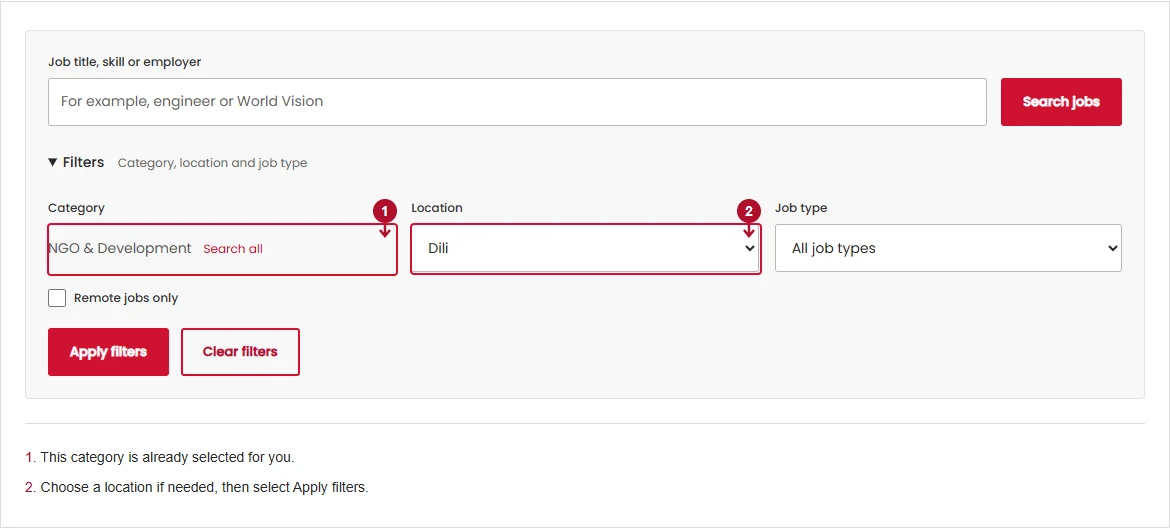
Check the original notice and the current deadline. Only describe qualifications, skills and achievements you can support.
Separate essential requirements from desirable experience. Check any national or international recruitment criteria.
Match real examples to the work. Do not assume similar job titles mean the same level of authority.
Read the actual duty station and travel requirements, not just the employer’s address.
Use the link or contact specified by the employer. A repost may not accept applications itself.
Prepare only the documents requested in the notice. Check file names, formats and the vacancy reference, then follow the employer’s application process.
Keep your final documents and submission confirmation. The checklist beside this text is a reminder for this visit, not an application form.
Read the full job-search guideYour checklist is for this visit only. It does not submit an application or measure your chances of being hired.
Find your next step
Explore related pages to plan your next step.
Explore employer profiles, then check each vacancy for its programme, duties and eligibility.
Explore CompaniesFind practical guidance on tailoring your CV and following the employer’s application instructions.
Read Career GuidesYour questions answered
Check these common questions before choosing your next step.
Check each notice for national, local-hire or international eligibility. A development project’s international funding does not mean every position is internationally recruited. Ask the employer if the eligibility wording is unclear.
Read the specific internship notice or ask the employer. Confirm any stipend, transport support, expected hours and supervision. Do not infer payment from the organisation’s name or assume an internship is an employment contract.
Compare it with the organisation’s official recruitment page and verify the application contact. Treat a request for fees or sensitive documents as a reason to check directly. UNDP states that it does not charge recruitment fees; verify other organisations’ policies separately.
It can provide relevant evidence if the role’s requirements allow it. Describe the organisation, dates, your responsibilities and what you learned or delivered. Label voluntary work clearly and do not present it as paid employment.
Read the contract rather than relying on the category label. A consultancy may focus on defined outputs and a delivery period; an employee role may have ongoing duties. Check the actual terms, application requirements and eligibility in each notice.
Your next opportunity
Compare the requirements, choose the right opportunity and follow the employer’s application instructions.